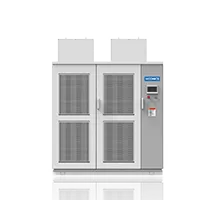
To know the inverter drive is to know what the inverter drive does ? A variable frequency drive (VFD) is a motor controller that drives an electric motor by changing the frequency and voltage of its power supply. The VFD is also able to control the ramp up and ramp down of the motor during start or stop, respectively. Although the drive controls the frequency and voltage of the power supplied to the motor, we usually refer to it as speed control because the result is the adjustment of the motor speed.
There are many reasons why we might want to adjust the speed of inverter drive motor. For example, to conserve energy and improve system efficiency; convert power in hybrid applications; match drive speed to process requirements; match drive torque or power to process requirements; improve operating conditions; reduce noise levels, such as from fans and pump noise; reduce mechanical stress on the machine to extend its life; reduce peak consumption to avoid peak demand prices and reduce the size of the motor required. Additionally, today's drives integrate networking and diagnostics for better control of performance and increased productivity. Therefore, energy saving, intelligent motor control, and peak current reduction are three important reasons to choose a VFD as the controller in every motor drive system.
For what an inverter drive does, there are many different types of drives available today as they are widely used in industry. Both single-phase VFDs and three-phase VFDs have been developed to suit a variety of applications. Differences in drive types include methods for frequency and voltage control; and harmonic suppression techniques. The most common use of VFDs is to control fans, pumps and compressors, which account for 75% of all drives in operation worldwide. Soft starters and jumper contactors are other less complex types of motor controllers. A soft starter is a solid state device that slowly accelerates to full speed during motor startup. A jumper contactor is a motor controller that applies full line voltage to the motor.
What does an inverter drive do? A variable frequency drive can use VFD control to vary the power supplied to match the energy demand of the driven equipment, which is how it saves energy or optimizes energy consumption. The drive can significantly reduce energy consumption compared to direct-on-line (DOL) operation, where the motor runs at full speed regardless of demand. Using a drive, it is common to save 40% in electricity or fuel. The rolling effect means that using a drive can also reduce the NOx emissions and CO2 footprint of the system in which it is installed.
The two fundamental inverter drive functions are controlling motor speed and controlling motor torque. However, modern inverter drives can perform several additional functions that help improve the operation of industrial motor systems.
Motor speed control is achieved primarily by adjusting the frequency supplied to the motor. Instead of forcing a motor to operate continuously at one fixed speed, the inverter drive can increase or decrease motor speed according to the actual requirements of the process.
Torque control is equally important in applications where the mechanical load changes during operation. Depending on the VFD and control method, the drive can regulate motor output so that the required torque is available under different operating conditions.
In addition to these two main functions of an inverter drive, modern VFDs can provide controlled acceleration and deceleration, forward and reverse operation, fault diagnostics, motor protection, current and voltage monitoring, and communication with PLCs and other industrial automation systems.
These functions make the inverter drive more than a simple speed controller. It becomes an important component for coordinating motor performance with the requirements of the complete industrial process.
An inverter drive controls a motor through a power-conversion process that converts fixed-frequency input power into adjustable-frequency output power.
A typical VFD contains three main power stages:
AC Input → Rectifier → DC Bus → Inverter → Variable-Frequency AC Output
First, the rectifier converts incoming AC electricity into DC electricity. The DC bus, also called the DC link or intermediate circuit, then smooths and stabilizes the rectified power.
Finally, the inverter section uses power semiconductor devices to convert the DC power back into AC electricity. Unlike the original fixed-frequency input, the frequency and voltage of this output can be controlled according to the required motor operating conditions.
By changing the output frequency, the inverter drive changes motor speed. The drive also coordinates voltage, current, and control parameters to provide suitable motor performance across the required operating range.
For a more detailed explanation of the rectifier, DC bus, inverter stage, PWM, and motor-speed relationship, see our guide to the variable frequency drive working principle.
When comparing a VFD vs inverter, the two terms may appear to describe the same equipment, especially in industrial motor-control applications. However, there is a technical distinction.
An inverter is fundamentally a power-electronic circuit or device that converts DC electricity into AC electricity. Inverters are used in many different applications, including solar power systems, energy storage systems, uninterruptible power supplies, electric vehicles, and motor drives.
A variable frequency drive is specifically designed to control an electric motor.
A typical VFD contains a rectifier, DC bus, inverter, control system, protection components, and communication functions. The inverter is therefore one important part of the complete VFD rather than the entire drive itself.
In industrial terminology, however, an inverter drive and a VFD are often used to describe the same general category of motor-control equipment because both terms commonly refer to equipment that varies motor frequency and voltage.
The easiest way to understand the difference is:
An inverter converts DC power into AC power.
An inverter drive uses inverter technology for motor control.
A VFD is a complete motor-control system that varies output frequency and voltage to regulate AC motor operation.
Therefore, when evaluating a variable frequency drive vs inverter, it is important to consider the intended application rather than relying only on the terminology.
An inverter drive and a soft starter can both reduce the electrical and mechanical impact of starting an electric motor, but their functions after startup are different.
A soft starter primarily controls motor voltage during startup. It gradually increases the voltage supplied to the motor so that acceleration occurs more smoothly than with direct-on-line starting. Once the motor reaches normal operating speed, continuous speed regulation is generally not the primary purpose of the soft starter.
An inverter drive provides control throughout the complete motor operating cycle. Because a VFD changes output frequency and voltage, it can continuously regulate motor speed after startup. Depending on the application and control method, it can also control torque, acceleration, deceleration, direction, and process operating conditions.
For applications that only require smoother motor starting, a soft starter may be sufficient. Applications requiring variable-speed operation or continuous process control generally require an inverter drive. For a more detailed comparison, see the difference between VFD and soft starter.
Choosing an inverter drive requires more than matching the drive's rated power with the motor nameplate. Motor voltage, rated current, motor power, load characteristics, required speed range, starting torque, overload capability, acceleration and deceleration requirements, control method, and operating environment can all affect VFD selection.
The load type is particularly important. Pumps and fans, for example, often have different torque characteristics from conveyors, crushers, mixers, or other constant-torque equipment. A drive selected for one type of load may therefore not be suitable for another application even when the motor power ratings appear similar.
For medium- and high-power industrial installations, additional factors such as input voltage, harmonic requirements, motor cable distance, cooling, environmental protection, communication interfaces, reliability, and maintenance requirements may also need to be evaluated.
Correct variable frequency drive selection should therefore be based on the complete motor and process requirements rather than motor power alone.
The two main functions of an inverter drive are motor speed control and motor torque control. By regulating frequency, voltage, and other motor-control parameters, the drive can adjust motor operation according to changing process requirements.
The main purpose of an inverter drive is to control an electric motor by adjusting the frequency and voltage supplied to it. This allows motor speed and output to better match the requirements of the driven equipment.
An inverter drive controls motor speed primarily by changing the frequency of the electrical power supplied to the motor. Reducing frequency generally reduces motor speed, while increasing frequency increases motor speed within the appropriate operating range.
In industrial motor-control applications, the terms inverter drive and VFD are commonly used interchangeably. Technically, however, the inverter is one of the power-conversion stages within a complete variable frequency drive.
An inverter converts DC electricity into AC electricity and can be used in many types of electrical systems. A VFD is specifically designed for AC motor control and normally includes a rectifier, DC bus, inverter, control system, and protection functions.
Yes, an inverter drive can reduce energy consumption when motor speed can be adjusted according to actual process demand. The potential savings vary according to the motor load, operating time, speed requirements, equipment type, and existing control method.